
For God has not given us a spirit of fear and timidity, but of power, love, and self-discipline.
2 Timothy 1:7
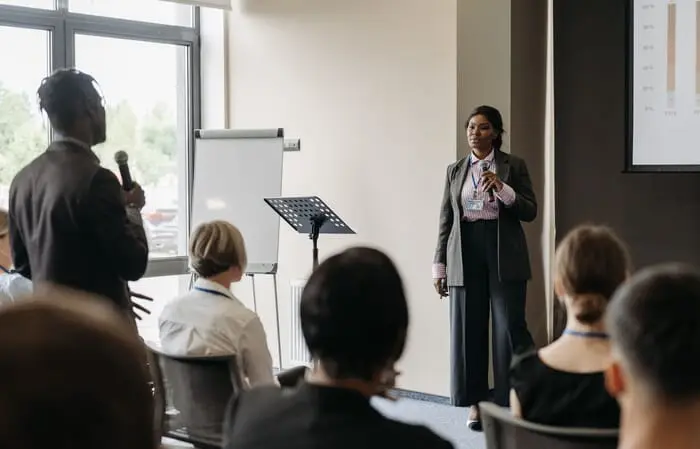
Public speaking is easily one of the most daunting aspects of professional life. Whether you're delivering a presentation, leading a meeting, pitching an idea, speaking at a networking event, or simply contributing in front of senior colleagues, standing up to speak can feel intimidating. Even experienced professionals often admit to feeling nervous before addressing a room full of people.
If you've ever felt your heart race before a presentation, worried about forgetting your words, or spent days overthinking an upcoming meeting, you're certainly not alone. Fear of public speaking is incredibly common, and for many people it doesn't disappear entirely, no matter how experienced they become.
With our Christianity, however, we have something that extends beyond confidence gained through experience or preparation. We have the assurance that God is with us wherever we go. That doesn't mean we will never feel nervous, but it does mean we never face those moments alone.
One of the biggest misconceptions about confident speakers is that they never experience fear. In reality, confidence is rarely the absence of nerves. More often, it is choosing to step forward despite them.
The Bible is full of people who questioned whether they were capable of speaking. When God called Moses to lead the Israelites out of Egypt, Moses immediately focused on what he believed was his greatest weakness.
But Moses pleaded with the Lord, “O Lord, I’m not very good with words. I never have been, and I’m not now, even though you have spoken to me. I get tongue-tied, and my words get tangled.”
Exodus 4:10
God didn't respond by finding someone more eloquent. Instead, He reminded Moses that He would be with him. That is an encouraging reminder for us today. God has never been limited by human ability. In fact, God repeatedly used ordinary people who felt underqualified, inexperienced, or inadequate.
Their confidence wasn't found in themselves - it was found in the God who had called them.
Many of us approach public speaking with our attention fixed firmly on ourselves. We imagine every possible thing that could go wrong, often long before we've even stepped into the room.
The problem with this mindset is that it keeps the focus on our performance rather than our purpose.
Instead of asking, "What if I embarrass myself?" try asking a different question: "How can I help the people listening?".
Whether you're presenting to colleagues, interviewing for a new role, leading a workshop, or speaking at church, your purpose is to communicate something that benefits others. You are there to share knowledge, offer encouragement, explain an idea, or help people make informed decisions.
When your focus shifts from yourself to serving your audience, the pressure begins to ease because success is no longer measured by perfection but by whether you've genuinely helped others.
However, sometimes people assume that trusting God means they don't need to practise or prepare. This is not the case - we know that faith and wisdom go hand in hand.
Know your material thoroughly. Practise your opening several times. Anticipate the questions people may ask. Familiarise yourself with the room if possible. The more prepared you are, the more mental capacity you'll have to engage with your audience rather than worrying about remembering every sentence.
Once you've prepared, however, there comes a point where further worrying serves no purpose. Many of us continue rehearsing worst-case scenarios right up until the moment we begin speaking. We imagine forgetting everything or people criticising our presentation.
Jesus reminds us not to be consumed by worry because worry has never changed tomorrow. Instead of allowing fear to dominate your thoughts, take a moment before you speak to pray. Ask God to calm your mind and help you communicate with wisdom. Sometimes the most powerful preparation you can do happens in those quiet moments of surrender before you walk into the room.
It's also worth remembering that your audience is usually far more supportive than you imagine. Most people aren't hoping you'll fail. They want you to succeed because your success often helps them understand something, solve a problem, or learn something new. Even if you stumble over a sentence or momentarily lose your train of thought, it's rarely as noticeable as it feels.
We are often our own harshest critics. Many accomplished speakers occasionally forget a word or lose their place. These moments don't ruin a presentation. In fact, they often make speakers appear more genuine and relatable.
We should also remember that our words carry influence beyond simply sharing information. Every conversation and presentation provides an opportunity to reflect Christ through the way we communicate. People notice patience when questions become difficult. They notice humility when we acknowledge we don't know an answer. They notice kindness in the way we respond to disagreement and respect in how we treat those who challenge us.
Long before people ask about our faith, they often observe our character. Public speaking therefore becomes more than a professional skill. It becomes another opportunity to honour God through excellence and integrity.
It is also important to remember that confidence grows over time. Few people become excellent speakers overnight. Like any skill, communication improves through experience and repetition. Every presentation you deliver, every meeting you contribute to, and every opportunity you accept helps build confidence for the next one. Don't allow fear to prevent you from accepting opportunities that God may be placing before you.
The presentation you're nervous about today may prepare you for leading a larger project next year. The meeting you hesitate to contribute to could become the experience that gives you confidence to interview for your next role. The speech that feels overwhelming today may one day encourage hundreds of people.
God often develops us gradually, using one opportunity to prepare us for the next. If fear continually keeps us saying no, we may miss opportunities He is using to shape our character and expand our influence.
As you prepare for your next presentation, remember that your confidence doesn't need to come from believing you'll perform perfectly. It comes from knowing that God is with you regardless of the outcome.
Do your preparation well. Practise diligently. Trust God completely.
He has given you the abilities you possess and the experiences that make your perspective unique. You don't need to speak exactly like someone else. God isn't looking for another version of somebody else.
The next time you stand to speak, whether it's to one colleague or one hundred people, take a deep breath, offer a simple prayer, and remember whose strength you are relying on.